


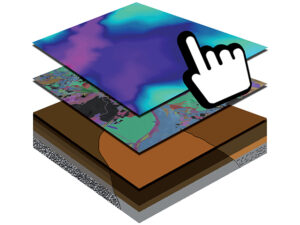
 Scientific research is engaged in the creation of know-how which often results in the development of models capable of improving both the understanding and the representation – sometimes in advance (predictions) – of some processes that take place in reality. These models contain and are an expression of advanced know-how in the field of application considered. By their nature and by the natural inclination of researchers, the know-how and models remain codified at a level that does not lend itself to being manipulated by non-experts and to communicating results to the latter. To fill this significant gap, CRISP researchers have been working for years to harness the power of know-how and models into simple-to-use decision support systems that can benefit many.
The applications are designed and administered via the web so that they can be reached by any user on the network without the need to install additional software. Decision support systems are technically cybernetic geospatial platforms, which if appropriately fed with environmental data (in particular on soil and climate) can offer a wide range of applications and responses thanks to the presence of models that represent the real “engines” of these platforms. The combination – on the one hand – of data characterized by high detail and accuracy and of advanced models with – on the other hand – low parameterization administered to the user through a simplified graphical interface is the current challenge of CRISP. This challenge manifests itself in the production of various applications that could support various sectors relating to agriculture, forestry and the environment.
At the following links it is possible to reach the first two Decision Support Systems created by CRISP: