


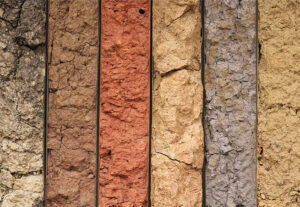
 CRISP pays great attention to soil as a cultural heritage and living testimony of the past. Linked to this function of the soil are the pedoarchaeological research and the production of soil monoliths that CRISP carries out among its activities. Pedoarchaeological research, applying knowledge and methods of pedology to the study of archaeological contexts, analyses the genesis, properties and characteristics of soils of the past in order to:
The pedoarchaeological investigation is conducted at multiple levels which include the analysis of field evidence, chemical-physical and micromorphological analyses, and the areal integration of archaeological and pedologic data.
In particular, micromorphological analysis through thin soil sections, allowing microscopic investigation of undisturbed samples, is particularly suitable to answer the numerous questions that modern archaeology poses.
Pedoarchaeological research is currently focused on the protohistoric sites of the so-called Palma Campania facies (Early Bronze Age in Campania) buried and preserved by the catastrophic Vesuvian eruption of the Avellino Pomici (3945 yr cal BP).
With the production of soil monoliths, CRISP aims to collect and preserve soil profiles representative of Campanian and Italian soil environments. Soil monoliths with pedological information are a useful tool for education and dissemination through the tangible display of a fundamental part of our ecosystem.
The construction of soil monoliths is divided into several complex phases. In short:
CRISP collaborated in the creation of the SOIL MUSEUM of Pertosa – the first permanent soil museum in Italy – also with the creation of 4 soil monoliths, coming from 4 different environments in Campania: Casal di Principe (CE), Monteforte Irpino (AV), Celle di Bulgheria (SA), Guardia Sanframundi (BN).